
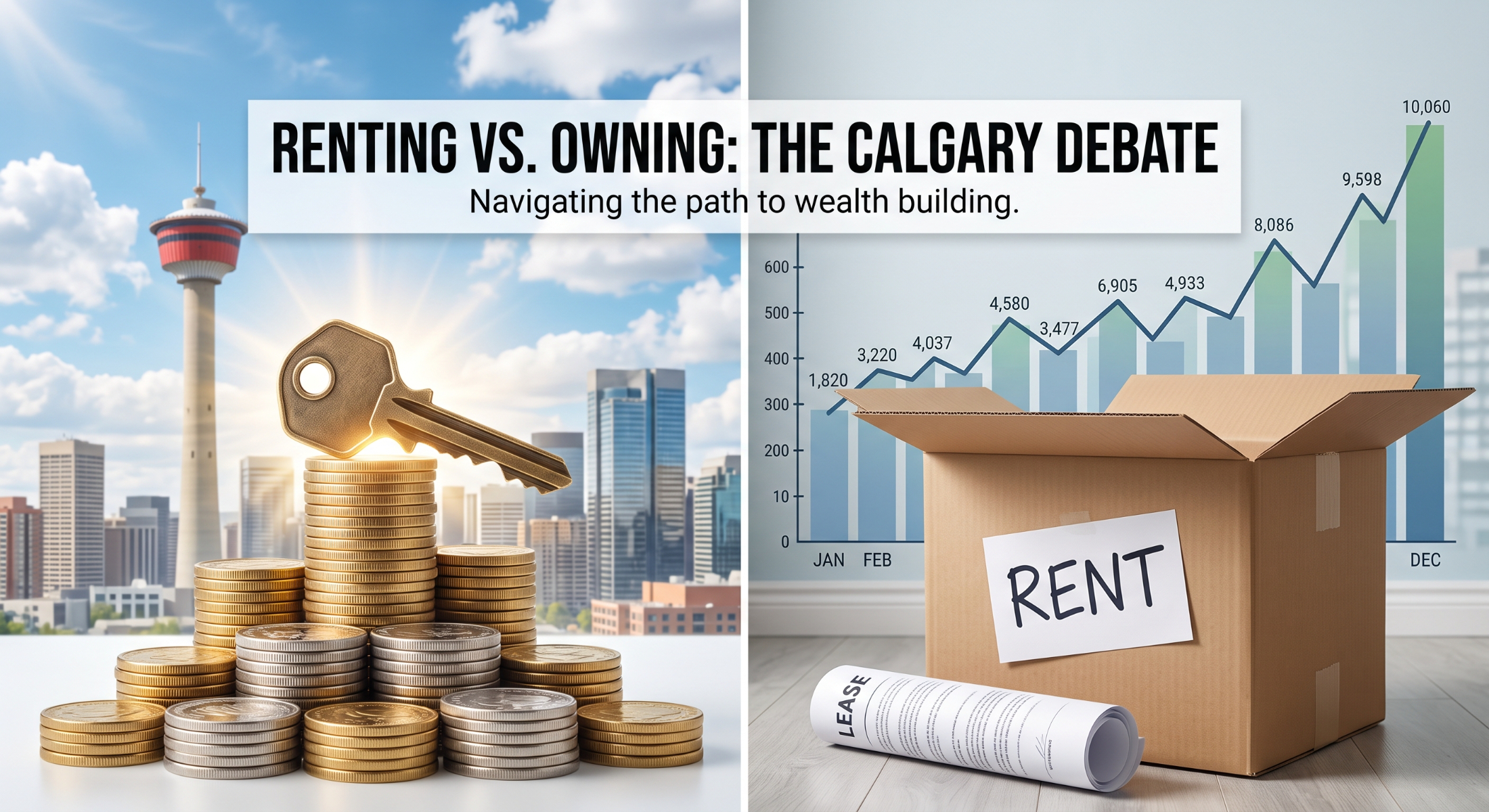
If you spend enough time on personal finance forums, you will inevitably stumble across a growing trend: the argument that renting is financially superior to owning. The logic usually goes something like this: “If I rent, my monthly costs are lower, I don’t have to pay for a new roof, and I can just invest my down payment into an ETF and come out ahead.”
On paper, in a perfect vacuum, the math can sometimes look competitive. Renting offers unmatched flexibility, and investing in the stock market is a proven wealth-building strategy.
But real life doesn't happen on a spreadsheet. When we look at how housing costs, inflation, tax incentives, and human behavior actually work over a 5 to 10-year horizon, homeownership consistently comes out on top. As a local Calgary realtor who sees the math behind these decisions every day, here is a deep dive into why owning a home remains the ultimate wealth-building tool for the average family.
1. The Power of Leverage and "Forced Savings"
The most common argument for renting is the "invest the difference" strategy. If renting costs $2,500 and owning costs $3,000, the renter can theoretically invest that $500 difference into the stock market every single month.
The problem? Most people don't actually do it. Human nature gets in the way, and that $500 often gets absorbed into lifestyle inflation, vacations, or upgrading vehicles. A mortgage, on the other hand, acts as an automatic, forced savings account. Every time you make a mortgage payment, a portion of it goes directly toward paying down your principal. You are effectively paying your future self.
Furthermore, real estate allows you to use leverage. If you put 5% down on a $500,000 home ($25,000) and the home appreciates by a conservative 3% in one year, your home gains $15,000 in value. That is a 60% return on your actual cash invested. You simply cannot get that kind of leveraged return in an ETF without taking on massive, high-risk margin debt.

2. The Opportunity Cost: What if I Invest My Down Payment?
Renters often point out that if they buy, their $25,000 to $100,000 down payment is "trapped" in the house instead of earning 7% in the stock market.
While it's true your down payment is tied up, Canadian homeowners have massive government incentives that offset this:
The Principal Residence Exemption: When you sell your primary home in Canada, 100% of the profit is tax-free. If you make $150,000 in the stock market, you will pay capital gains tax. If your house goes up $150,000, every single penny goes into your pocket.
The FHSA and HBP: The Canadian government actively helps you save that down payment. The First Home Savings Account (FHSA) allows you to save up to $40,000 completely tax-free, while the Home Buyers' Plan (HBP) lets you borrow up to $60,000 from your RRSP.
3. Fixing Your Cost of Living in an Inflating World
When you sign a lease, your housing costs are at the mercy of the market. In provinces like Alberta where there is no rent control, landlords can increase rent to match market demand at the end of every lease term. Calgary alone has seen significant rent increases over the last few years.
When you secure a mortgage, you fix the largest line item in your budget. Yes, property taxes and insurance will inch up, and in Canada, mortgages must be renewed every 1 to 5 years at current interest rates. However, as the years go by, your principal balance shrinks. Ten years into a mortgage, your payments are servicing a much smaller debt, while the renter down the street is paying 10 years' worth of compounded rent increases.
4. The 10-Year Math: Equity vs. Sunk Costs
Let’s look at a realistic 10-year scenario. Assume you buy a $500,000 home with 5% down versus renting a similar home starting at $2,500/month (with a conservative 3% annual rent increase).
Note: This does not factor in property taxes or maintenance, but even after subtracting those, the homeowner is hundreds of thousands of dollars ahead.
5. The "Maintenance Money Pit" is Overstated
Renters often point to home maintenance as the ultimate dealbreaker. "What if the furnace breaks? What if the roof leaks?"
Maintenance is a reality of homeownership, but it is rarely the catastrophic annual drain it’s made out to be. High-ticket items like a roof or a furnace typically have lifespans of 15 to 25 years. You do not replace them constantly. In many cases, the biggest unexpected expense a homeowner might face over a multi-year span is a $2,000 appliance upgrade. The rest is often made up of minor trips to the hardware store for basic upkeep.

6. The Calgary Advantage
While real estate dynamics change depending on where you live, buying in Calgary offers distinct advantages over other major Canadian cities:
No Land Transfer Tax: Buying a home in Toronto or Vancouver requires tens of thousands of dollars upfront just in taxes. In Alberta, you only pay nominal land title registration fees, keeping your cash in your pocket.
The "Infinite Land" Myth: You will often hear that Calgary has "infinite land" to build on. While the city is surrounded by prairie, converting acreage into zoned, serviced, and constructed communities takes years of municipal approvals and development. This bottleneck ensures that existing housing supply retains its value.
Pets and Freedom: Calgary has a famously competitive rental market for pet owners. Finding a rental that allows a dog—without charging exorbitant non-refundable pet fees or monthly "pet rent"—is incredibly difficult. When you own your home, your furry family members are always welcome, and you have complete freedom to renovate and design your space.
So, When Should You Rent?
Real estate is a long-term game. If your job is highly volatile, you are testing out a brand new city, or you plan on moving again in less than 3 to 4 years, renting is absolutely the right call. The transaction costs of buying and selling real estate (realtor fees, legal costs, moving) will wipe out your equity gains if you flip properties too quickly.
But if you are putting down roots and looking at a 5-to-10-year horizon, the math is clear. Buying a home isn't just about having a place to paint the walls whatever color you want—it is the financial bedrock of the Canadian middle class.
Are you trying to decide if it's the right time to make the leap from renting to owning?
Every situation is unique, and having the right advice makes all the difference. Reach out to the Nasiri Property Group today. We’d love to sit down, run through your specific numbers, and help you build a personalized strategy for your real estate goals.
Comments:
Post Your Comment: